
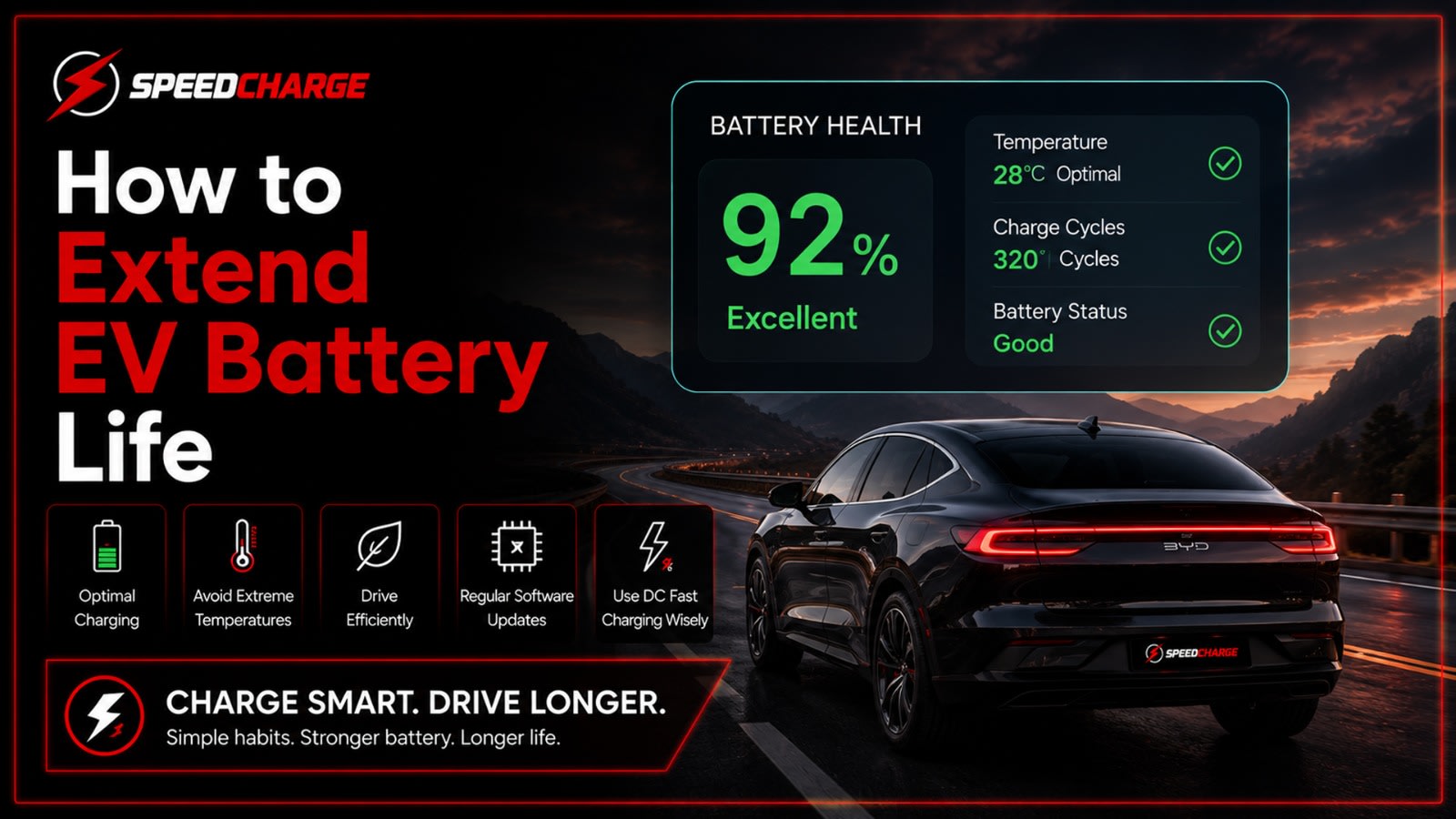
The battery is one of the most valuable components in an electric vehicle, so battery longevity naturally becomes an important question for anyone planning to keep an EV for several years.
Protecting EV battery life is not about following one rigid charging percentage or avoiding fast chargers completely. Battery ageing depends on chemistry, temperature, State of Charge, charging rate, thermal management, driving pattern, calendar age and the way the manufacturer has designed the usable battery window.
Modern electric vehicles also actively manage their batteries. The Battery Management System monitors temperature, voltage, current and State of Charge and can change charging or power behaviour when necessary.
The result is simple: good habits can support long-term battery health, but owners do not need to micromanage every percentage point.
For a deeper technical explanation of capacity loss, read the SpeedCharge EV Battery Degradation Guide.
What Determines EV Battery Life?
Electric-car batteries gradually lose some usable capacity as they age. This process is known as battery degradation.
Degradation occurs through a combination of calendar ageing and cycle ageing.
Calendar ageing happens simply as the battery becomes older, even if the vehicle is driven relatively little.
Cycle ageing is associated with charging and discharging the battery over time.
Research and modelling from NREL show that battery lifetime can vary with factors including charge/discharge rate, ambient temperature and State-of-Charge history, alongside battery chemistry and design.
Main Factors Affecting an EV Battery
Factor | Why It Matters | Owner Control |
|---|---|---|
Battery chemistry | Different chemistries age differently | Low |
Battery design | Cooling and usable capacity differ by vehicle | Low |
Ambient temperature | Extreme conditions affect battery behaviour | Partial |
State of Charge | Long periods at extremes can add stress | High |
Charging rate | Higher rates can add thermal/electrochemical stress | Medium |
Driving behaviour | High power demand can increase energy use and heat | Medium |
Calendar age | Batteries age even when lightly used | None |
Thermal management | Helps maintain battery operating conditions | Mostly vehicle-controlled |
Storage habits | Long periods unused can matter | High |
Software/BMS | Controls battery operating limits | Manufacturer-controlled |
This is why two vehicles with similar odometer readings can show different battery condition after several years.
How Long Do Electric Car Batteries Last?
There is no single lifespan that applies to every electric vehicle.
The U.S. Department of Energy's Alternative Fuels Data Center says EV batteries are designed for extended service life and notes that many manufacturers offer battery warranties around eight years or 100,000 miles in the U.S. It also emphasises that battery chemistry, climate, usage and charging behaviour influence actual longevity.
For Indian owners, warranty duration and mileage should always be checked for the specific model sold in India.
Do not assume an eight-year warranty means:
The battery will fail after eight years.
The battery is guaranteed to remain at 100% capacity for eight years.
Every manufacturer uses the same degradation threshold.
Every form of degradation is covered.
A replacement battery is automatically provided after a certain percentage loss.
Battery warranty and expected battery lifespan are two different things.
Battery Warranty Is Not Battery Lifespan
A warranty is a contractual commitment from the manufacturer under defined conditions.
It may cover:
Manufacturing defects
Battery-system faults
Minimum State of Health under defined conditions
Specific components
Defined time or kilometre limits
The details vary between manufacturers.
A battery can remain usable well after its warranty expires, just as warranty expiration does not mean the battery suddenly needs replacement.
DOE has also highlighted U.S. data showing that full battery replacements caused by failure have been relatively uncommon in newer plug-in vehicles, although that dataset should not be treated as a direct prediction for every Indian EV.
What Is EV Battery State of Health?
State of Health (SoH) is an estimate of how the battery's current condition compares with its condition when new.
It should not be confused with State of Charge (SoC).
Term | Meaning |
State of Charge | How full the battery is now |
State of Health | Estimate of long-term battery condition |
Battery capacity | Amount of usable energy the battery can store |
Range | Distance the vehicle can travel under particular conditions |
SoH is manufacturer- and system-dependent. Different diagnostic systems can calculate or report it differently.
A lower displayed driving range also does not automatically prove severe degradation because range is affected by speed, climate control, weather, tyre pressure, elevation and driving history.
How Heat Affects EV Battery Life
Temperature is an important factor in lithium-ion battery ageing.
High temperatures can accelerate chemical reactions inside battery cells. At the same time, high-power charging and driving can produce additional heat internally.
Modern EVs compensate using thermal-management systems and Battery Management Systems, but the effectiveness of those systems varies between vehicles.
DOE research into high-power lithium-ion charging identifies heat generation as an important engineering challenge as charging rates rise.
Practical Advice for Indian Summers
You do not need to stop using the car when outside temperatures become high.
Instead:
Use shaded or covered parking when practical.
Do not obstruct vehicle cooling systems.
Allow the vehicle to manage battery temperature automatically.
Pay attention to thermal or charging warnings.
Use battery preconditioning where the vehicle supports it.
Follow manufacturer guidance after unusually high battery temperatures.
Do not apply a fixed “wait 30 minutes before charging” rule unless your vehicle manufacturer recommends one.
For hot-weather charging guidance, read Is EV Charging Safe in Summer?.
Should You Follow the 20–80% Rule?
The popular 20–80% rule can be a useful strategy for some EV owners, but it is not a universal battery requirement.
Battery chemistry matters.
Some manufacturers recommend a lower daily charging target for certain battery packs, while other vehicles—particularly some using LFP chemistry—can have different charging recommendations, including periodic higher charging targets for battery-management calibration.
The correct rule is:
Use the manufacturer's recommended daily charging limit for your specific vehicle.
Avoid turning one general battery-care recommendation into a rule for every EV sold in India.
Is Charging an EV to 100% Bad?
Charging to 100% is not automatically harmful or unsafe.
A higher State of Charge can be useful when:
Starting a long highway journey
Entering an area with limited charging
Travelling through difficult terrain
Your destination has no charger
The manufacturer recommends periodic full charging
The bigger battery-health consideration is often how long the battery remains at an extreme State of Charge, rather than simply touching a particular percentage.
If you need maximum range, use it.
If you do not need maximum range every day, follow your manufacturer's normal daily target.
Should You Let an EV Battery Reach 0%?
Deliberately driving the battery to its lowest displayed State of Charge before every recharge provides no practical advantage for a modern lithium-ion EV.
You also need enough reserve for:
Traffic diversions
Unexpected weather
Charger outages
Route changes
Detours
Elevation changes
There is therefore little reason to turn deep discharge into a routine.
Charge when it fits your driving schedule and follow manufacturer recommendations.
Does DC Fast Charging Reduce EV Battery Life?
DC fast charging can create greater thermal and electrochemical demands than lower-power charging under some conditions, but its real effect depends on the battery, charging protocol, temperature, thermal management and frequency of use.
It is therefore inaccurate to say that every fast-charging session meaningfully damages the battery.
NREL modelling has shown that realistic fast-charging impact depends heavily on factors such as usage patterns, climate and thermal management rather than charger power alone. DOE research similarly examines charging protocols and heat management as key variables in high-rate battery charging.
When DC Fast Charging Makes Sense
Use it when speed has practical value:
Highway travel
Intercity journeys
Urgent top-ups
Taxi operations
Fleet operations
Days with unusually high mileage
Drivers without convenient home charging
For routine overnight parking, AC charging may simply be more convenient.
That is a use-case decision—not a rule that AC is inherently “good” and DC inherently “bad.”
Read EV Fast Charging in India: Myths & Facts for the complete explanation.
AC Charging vs DC Fast Charging for Battery Care
Factor | AC Charging | DC Fast Charging |
Common use | Home/workplace/destination | Public/highway/fleet |
Charging power | Generally lower | Higher |
Charging time | Longer | Shorter |
Battery thermal load | Vehicle-dependent | Can be higher |
Best use | Long parking periods | Time-sensitive charging |
Battery management | Vehicle controlled | Vehicle controlled |
Recommended strategy | Use as convenient | Use when speed is valuable |
Battery health should not be reduced to simply choosing AC over DC.
Charging Before a Long Road Trip
A long journey is exactly when additional battery range can be valuable.
Charge high enough before departure to comfortably reach the next reliable charging stop.
During the trip, consider:
Vehicle charging curve
Distance to next charger
Available backup charger
Route elevation
Weather
Traffic
Charger reliability
Required arrival reserve
Many vehicles reduce charging power at higher States of Charge, so charging all the way to 100% at every highway stop may increase waiting time unnecessarily.
But stopping at exactly 80% is not mandatory either.
The correct departure percentage is the one that provides enough range and safety margin for the next route section.
Use the SpeedCharge Station Finder to plan charging stops before longer journeys.
Battery Preconditioning Before Fast Charging
Some EVs can prepare battery temperature before reaching a DC fast charger.
Where supported, this can help the battery approach conditions intended for higher charging performance.
Implementation varies.
Some vehicles activate preconditioning when a fast charger is selected in built-in navigation. Others provide different controls, while some vehicles do not have active battery preconditioning.
Always check the owner's manual rather than assuming your EV has this feature.
Does Aggressive Driving Damage the Battery?
Aggressive acceleration can increase energy consumption and battery power demand, especially during repeated high-load driving.
However, there is no need to treat occasional hard acceleration as if it immediately damages the battery.
A smoother driving style can help:
Reduce energy consumption
Improve range
Reduce tyre wear
Improve passenger comfort
For battery longevity, long-term thermal and charging conditions are generally more useful to think about than obsessing over occasional acceleration.
Does Regenerative Braking Improve Battery Health?
Regenerative braking recovers some kinetic energy while slowing the vehicle and returns it to the battery.
Its primary benefits are:
Improved efficiency
Reduced friction-brake use
Energy recovery in suitable driving conditions
It should not be marketed as a major battery-life preservation technique.
Use regenerative-braking settings according to driving conditions and personal preference rather than maximising regen solely because you believe it will dramatically extend battery longevity.
How to Store an EV for Several Weeks or Months
Long-term storage deserves different treatment from everyday charging.
Avoid assuming every EV should be stored at exactly 50% or 60%.
Instead:
Read the manufacturer's long-term storage guidance.
Use a dedicated storage mode if provided.
Avoid intentionally leaving the battery extremely low.
Avoid leaving it unnecessarily at maximum charge for prolonged periods unless manufacturer guidance says otherwise.
Check the vehicle periodically if storage is extended.
Consider 12V battery requirements as well as the traction battery.
Some vehicles have different recommendations depending on battery chemistry and expected storage duration.
What About Leaving the EV Plugged In?
Some manufacturers design their vehicles to remain connected during extended parking so the vehicle can manage battery condition according to configured limits.
Others provide different guidance.
The correct approach is manufacturer-specific.
Do not automatically unplug a vehicle for weeks because an internet article says charging is bad, and do not automatically leave every EV at 100% indefinitely.
Does Parking in Shade Help?
Shade can reduce solar heating of the cabin and exterior surfaces and can reduce the amount of energy needed for cabin cooling.
The traction battery is usually located away from direct cabin sunlight, so claims that simply parking in shade will dramatically extend battery lifespan are too strong.
Still, avoiding unnecessary heat exposure where convenient is a sensible habit—especially in India's hottest months.
Battery Chemistry Matters: LFP vs Nickel-Based Packs
Not every EV battery uses the same chemistry.
Two commonly discussed families are:
LFP — Lithium Iron Phosphate
LFP batteries are known for thermal stability and cycle-life characteristics that make them attractive for many EV applications.
Nickel-Based Chemistries
Battery packs using nickel-rich cathodes can provide high energy density, which can help achieve more range for a given pack weight.
But neither chemistry should automatically be described as “better.”
Vehicle manufacturers optimise:
Cell chemistry
Cooling
Charging limits
Usable capacity
BMS strategy
Battery packaging
This is another reason universal charging rules are unreliable.
How to Extend EV Battery Life Without Overthinking It
There are a few habits that provide useful battery care without making EV ownership inconvenient.
1. Follow the Manufacturer's Daily Charge Target
Use the charging limit intended for your battery chemistry and vehicle.
2. Avoid Unnecessary Long Periods at Extreme Charge
If you do not need maximum range immediately, there is usually no benefit in deliberately keeping the battery at an extreme State of Charge for prolonged periods.
3. Use Fast Charging When You Need It
High-power charging is a tool, particularly for long journeys.
4. Let Thermal Management Work
Do not bypass cooling systems, charger controls or battery-protection behaviour.
5. Use Correct Charging Equipment
Install a properly rated home charger and electrical circuit rather than relying on improvised high-load connections.
6. Follow Storage Instructions
Long-term storage is one area where manufacturer-specific instructions are particularly important.
7. Keep Software Updated
Battery and charging behaviour can be influenced by vehicle software and BMS updates.
For residential charging, read How to Charge an EV at Home in India and the Best EV Charger in India Buying Guide.
Habits That Matter vs Habits That Are Overrated
Habit | Priority |
Follow OEM charging guidance | High |
Avoid unnecessary prolonged extreme SoC | High |
Keep charger/electrical system healthy | High |
Respond to battery warnings | High |
Use appropriate thermal-management features | High |
Avoid all DC fast charging | Unnecessary |
Always stop charging at exactly 80% | Too rigid |
Always drain battery before charging | Wrong approach |
Charge to 100% every night regardless of need | Usually unnecessary |
Never accelerate hard | Overly restrictive |
Calculate every charging cycle manually | Unnecessary |
How Do You Know if an EV Battery Is Degrading?
Some capacity loss over time is normal.
Possible indicators include:
Gradual reduction in usable energy
Reduced real-world range under comparable conditions
Manufacturer diagnostic results
State-of-Health information where available
Significant change in charging behaviour
Battery warning messages
Do not diagnose degradation from one low-range trip.
Compare performance across similar:
Routes
Speeds
Weather
Tyre pressures
HVAC use
Payload
A professional manufacturer diagnostic is more reliable than estimating battery health only from dashboard range.
Normal Degradation vs Battery Fault
Battery ageing and battery failure are different.
Gradual degradation generally means the battery stores less usable energy as it ages.
A battery fault can involve:
Diagnostic warning
Cell/module imbalance
Charging failure
Sudden abnormal capacity change
Thermal-management fault
Isolation fault
Unexpected power limitation
If battery performance changes suddenly rather than gradually, have the vehicle professionally diagnosed.
Does an Old EV Battery Need Complete Replacement?
Not always.
What happens after a battery issue depends on the manufacturer's battery architecture and repair policy.
Possible outcomes can include:
Software diagnosis
Connector/electrical repair
Cooling-system repair
Module-level service where supported
Battery-pack repair
Complete pack replacement
Never assume that every battery warning requires buying an entirely new traction battery.
Likewise, avoid publishing a generic “EV battery replacement cost in India” without specifying the vehicle because pack sizes, chemistries, warranties and manufacturer service policies vary enormously.
EV Battery Warranty: Questions to Ask Before Buying
Before purchasing an EV, ask the dealer:
How long is the traction-battery warranty?
What kilometre limit applies?
Is a minimum capacity/SoH threshold included?
How is State of Health measured?
What exclusions apply?
Is commercial use covered differently?
Are fast charging or charging habits mentioned in warranty terms?
Are battery modules repairable separately?
What happens if one module fails?
Is the warranty transferable to the next owner?
Get the terms from the official warranty document rather than relying only on a salesperson's explanation.
Does Battery Health Affect EV Resale Value?
Battery condition can become increasingly important as the used-EV market grows.
A buyer may want evidence of:
Battery warranty status
State of Health
Service history
Battery repairs
Charging faults
Accident history
Flood exposure
Maintaining service and diagnostic records can therefore be useful beyond simply keeping the vehicle operational.
Battery Myths to Avoid
“You must always stay between 20% and 80%.”
Too absolute. Follow your vehicle's battery recommendations.
“Charging to 100% destroys the battery.”
False. Higher charging levels can be useful when range is required.
“DC fast charging should never be used.”
False. It is a normal part of EV operation for compatible vehicles.
“An eight-year warranty means the battery lasts eight years.”
Warranty duration is not the same as physical lifespan.
“You should drain the battery before recharging.”
Modern lithium-ion EV batteries do not need this routine.
“A lower range reading means the battery is failing.”
Not necessarily. Weather, driving style, HVAC use and route conditions can all alter range.
A Practical Battery-Care Routine for Indian EV Owners
For normal daily ownership:
Set the charging target recommended by your manufacturer.
Charge when it fits your schedule.
Avoid unnecessary deep discharge.
Use the additional range of a full charge when you actually need it.
Use compatible DC fast charging during travel.
Keep charging equipment properly maintained.
Park in shade when convenient during extreme heat.
Follow battery warnings.
Maintain tyre pressure.
Keep vehicle software updated.
Follow manufacturer guidance for long-term storage.
Battery care should make EV ownership easier—not turn charging into a daily calculation exercise.
How SpeedCharge Supports Better Charging Habits
SpeedCharge provides charging guidance and infrastructure solutions for home, public and commercial EV charging.
Drivers planning daily residential charging can start with the SpeedCharge Home EV Charging Guide, while those comparing charging hardware can review the EV Charger Features & Buying Guide.
For highway journeys, drivers can use the SpeedCharge Station Finder and review the EV Fast Charging Guide before planning charging stops.
Final Thoughts
The best way to protect EV battery life is not to obsess over one number. Battery chemistry, temperature, State of Charge, charging rate, thermal management and calendar age all work together.
Follow your manufacturer's charging recommendations, avoid unnecessary prolonged extremes, use fast charging when its convenience is useful and let the vehicle's BMS manage the battery as designed.
Modern EV batteries are engineered for long service. Good charging and storage habits can support that longevity, but the goal should be sensible ownership rather than treating every charging session as a battery-health emergency.
Frequently Asked Questions
FAQ
Frequently asked questions
1. How long does an EV battery last?
There is no universal lifespan. Battery chemistry, thermal management, climate, charging pattern, vehicle design and age all affect longevity. Check the warranty and battery guidance for the specific vehicle.
2. Does charging to 100% damage an electric-car battery?
Not automatically. Charging higher is useful when additional range is needed. Follow the manufacturer's recommended daily charging target and avoid unnecessary prolonged extreme States of Charge.
3. Is the 20–80% charging rule compulsory?
No. It can be a useful strategy for some batteries and use cases, but different vehicles and chemistries can have different manufacturer recommendations.
4. Does DC fast charging damage EV batteries?
High-power charging can create additional thermal and electrochemical stress under some conditions, but the real impact depends on frequency, chemistry, temperature and thermal management. Occasional supported fast charging is normal EV use.
5. Does hot weather reduce battery lifespan?
High temperature can contribute to lithium-ion battery ageing. Modern EVs use thermal-management and battery-control systems to manage battery conditions.
6. Should I let my EV battery reach 0% before charging?
No routine deep discharge is required. Charge when convenient and maintain enough range reserve for normal driving and unexpected route changes.
7. What is State of Health in an EV battery?
State of Health is an estimate of the battery's long-term condition compared with when it was new. The way it is calculated can differ between manufacturers.
8. Should I charge my EV to 100% before a road trip?
Charging high can be useful when you need maximum range. Plan according to your route, charger availability and the manufacturer's recommendations.
9. What percentage should an EV battery be stored at?
There is no universal storage percentage for every vehicle. Check the manufacturer's long-term storage recommendation and use a storage mode where available.
10. How can I check whether my EV battery is healthy?
Use manufacturer diagnostics or State-of-Health information where available. Avoid judging battery condition only from one dashboard range reading because driving and environmental conditions also affect range.
