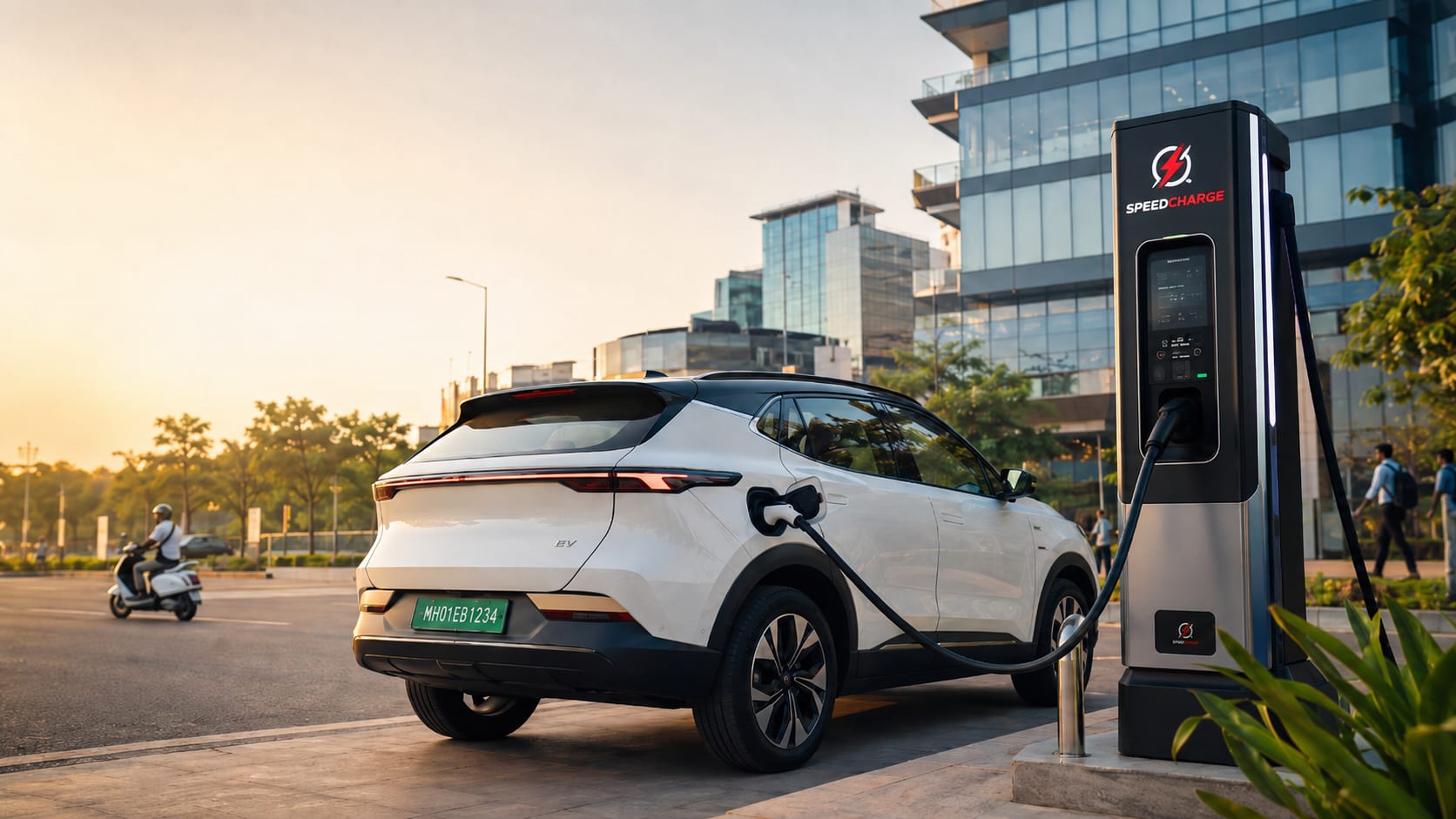
The Delhi EV Policy 2026 marks a major reset of the capital's electric-mobility strategy. Formally notified on 30 June 2026 and effective from 1 July 2026, the policy runs to 31 March 2030 and combines vehicle incentives, scrappage benefits, charging-infrastructure expansion, fleet electrification and battery-recycling measures.
For EV buyers, the most immediate questions are about subsidies, road tax and whether electric cars receive purchase incentives. For charging operators and property owners, the bigger changes involve Delhi Transco Limited's expanded role, a proposed single-window clearance system, community charging and new charging requirements for vehicle dealerships.
The policy also introduces phased electrification mandates for selected vehicle categories. Importantly, some claims circulating online—such as an immediate blanket ban on new petrol and diesel private cars—do not reflect the notified policy.
Delhi already entered the new policy period with a sizeable EV base. The Delhi Economic Survey 2025–26 recorded 470,104 registered EVs as of 19 March 2026. It also reported 91,031 beneficiaries receiving ₹203.35 crore in EV subsidy under the previous framework, while Delhi had 3,100 charging stations and 893 battery-swapping stations as of 31 March 2025.
What Delhi EV Policy 2026 Changes From the Previous Phase
The new framework is broader than a simple buyer-subsidy programme. It combines targeted incentives with stronger infrastructure and regulatory measures designed to accelerate specific vehicle categories where utilisation and pollution impact can be significant.
Policy at a Glance
Area | New 2026–2030 Framework | Why It Matters |
|---|---|---|
Policy validity | Effective 1 July 2026 to 31 March 2030 | Provides a multi-year implementation window |
Electric two-wheelers | Purchase incentive tapers over first 3 years | Front-loads adoption support |
E-autos | Year-wise purchase incentives | Supports commercial three-wheeler transition |
N1 electric goods vehicles | Tiered purchase incentives | Targets urban logistics |
Private electric cars | No general purchase subsidy listed | Support mainly through scrappage/tax benefits |
Scrapping | Incentives across multiple vehicle categories | Links EV adoption with retirement of older ICE vehicles |
Charging | DTL-led planning and single-window mechanism | Intended to simplify infrastructure rollout |
Dealer charging | Public charging required at authorised dealerships | Expands distributed charging access |
Registration mandates | Phased for selected two-/three-wheelers and goods vehicles | Moves beyond voluntary adoption |
Battery lifecycle | Recycling, EPR and traceability measures | Adds circular-economy focus |
The Delhi Budget 2026–27 separately proposed ₹200 crore for Delhi Electric Vehicle Policy 2.0, with the Budget Speech linking the allocation to purchase incentives, scrapping incentives and charging infrastructure. An additional ₹320 crore was proposed for electrification of bus depots, charging infrastructure and related capital infrastructure.
Delhi EV Subsidy 2026: Which Vehicles Get Purchase Incentives?
Under the Delhi EV Policy 2026, the strongest direct purchase incentives target electric two-wheelers, e-autos and N1 goods vehicles rather than private passenger cars.
Applicants must use eligible, approved vehicle models. The operational guidelines require an eligible purchase-incentive application to be submitted through the designated portal within 30 days of generation of the Registration Certificate. The eligible amount is intended to be disbursed within 60 days of application, subject to verification and fulfilment of requirements.
Purchase Incentives Under the New Policy
Vehicle Category | Year 1 | Year 2 | Year 3 | Key Eligibility |
|---|---|---|---|---|
Electric two-wheeler | ₹10,000/kWh, max ₹30,000 | ₹6,600/kWh, max ₹20,000 | ₹3,300/kWh, max ₹10,000 | Ex-showroom price up to ₹2.25 lakh |
E-auto L5M | ₹50,000 | ₹40,000 | ₹30,000 | Minimum 4 kWh battery; plug-in/swapping eligible |
N1 goods EV above 1.75t GVW | ₹1,00,000 | ₹75,000 | ₹50,000 | Eligible approved model |
N1 goods EV up to 1.75t GVW | ₹50,000 | ₹37,500 | ₹25,000 | Eligible approved model |
Private electric car | No general purchase incentive specified | — | — | Other policy benefits may apply |
The two-wheeler incentive applies to both plug-in and battery-swapping models. The final policy also links model eligibility to relevant central schemes and technical criteria.
Why the Incentive Reduces Each Year
The tapering structure encourages buyers to adopt earlier without committing the same level of public subsidy throughout the entire policy period.
For someone already considering an eligible electric two-wheeler, the first policy year can therefore offer a materially different state incentive from the third year.
However, the amount should never be assumed from the vehicle's battery size alone. Buyers should verify that the exact model appears on the approved list and meets the applicable eligibility conditions before treating the subsidy as part of the purchase budget.
Does Delhi Give a Subsidy on Electric Cars in 2026?
This is one of the most important distinctions in the new policy.
The notified framework does not list a general purchase incentive for private non-transport electric cars similar to the two-wheeler, e-auto and N1 goods-vehicle incentives.
Private electric-car buyers can instead potentially benefit from:
Scrapping incentive, where conditions are satisfied
Road-tax exemption for qualifying EVs
Registration-fee exemption for qualifying EVs
That makes headlines such as “Delhi gives every electric-car buyer ₹1 lakh subsidy” misleading.
The ₹1 lakh benefit is specifically a scrapping incentive, not a blanket EV-car purchase subsidy.
EV Scrapping Incentives in Delhi
One of the strongest features of the new framework is its attempt to combine EV adoption with retirement of older vehicles.
For most relevant categories, the replacement EV must be purchased within six months of issuance of the Certificate of Deposit by an authorised scrapping facility. Conditions differ by category, so buyers need to verify the exact rule before scrapping an existing vehicle.
Scrapping and Tax Benefits
Vehicle / Benefit | Policy Benefit | Important Conditions |
|---|---|---|
Electric two-wheeler replacement | ₹10,000 scrapping incentive | Delhi-registered BS-IV or below 2W; conditions apply |
E-auto L5M replacement | ₹25,000 | Delhi-registered BS-IV or below 3W |
Private electric car | ₹1,00,000 | New EV ≤₹30 lakh ex-showroom; eligible old Delhi BS-IV/below car; first 1 lakh eligible applicants |
N1 electric goods carrier | ₹50,000 | Scrapping eligible Delhi BS-IV/below N1 vehicle |
Electric Gramin Sewa replacement | ₹15,000 | New eligible electric Gramin Sewa within prescribed period |
EV car ≤₹30 lakh | 100% road-tax and registration-fee exemption | Purchased and registered in Delhi; policy conditions |
EV car >₹30 lakh | No road-tax/registration-fee exemption | As specified in final policy |
The ₹1 lakh electric-car scrapping incentive is capped to the first 1,00,000 eligible applicants and applies to qualifying EVs with an ex-showroom price not exceeding ₹30 lakh.
Road Tax and Registration Fee Exemption
The policy retains substantial tax support but introduces an important price threshold for electric cars.
Electric cars priced up to ₹30 lakh ex-showroom and purchased and registered in Delhi qualify for 100% exemption from road tax and registration fees through 31 March 2030.
Electric cars with an ex-showroom price above ₹30 lakh do not receive this exemption under the notified policy.
This price distinction should be considered when comparing on-road prices between EVs in different segments.
Charging Infrastructure: One of the Biggest Policy Changes
The Delhi EV Policy 2026 is not only a vehicle-subsidy programme. A substantial part of the framework is designed around public, community and private charging infrastructure.
Delhi Transco Limited, through the Power Department, has been assigned the nodal role for planning, coordination and implementation of public EV charging and battery-swapping infrastructure. It is also tasked with assessing future EV electricity-load requirements alongside DISCOMs.
Charging Infrastructure Measures
Policy Measure | What It Means | Potential Impact |
|---|---|---|
DTL as nodal agency | Central planning and coordination | More structured infrastructure rollout |
Single-window facility | Intended for charge-point and swapping operators | Faster clearance/connection process |
Public & community charging funding | State may seek PM E-DRIVE and allocate funds | More infrastructure deployment |
RWA/community charging | Residential communities encouraged to deploy charging | Better apartment EV access |
Private-sector participation | DISCOMs, private entities and developers encouraged | Creates commercial opportunities |
Dealer charging mandate | Every authorised dealership to have specified public charging | More distributed public access |
Grid planning | DTL/DISCOM demand forecasting | Better long-term power planning |
ToD tariff exploration | Differential charging-price structures may be considered | Could encourage off-peak/efficient charging |
The policy explicitly encourages RWAs, Group Housing Societies, residential communities and private entities to facilitate community/private charging. This can help address one of Delhi's biggest EV-ownership problems: residents who have parking but lack a straightforward charging arrangement.
Apartment committees planning this transition can also review EV Charging in Apartments & RWAs and RWA Government Guidelines for EV Charging Installation.
Delhi's Single-Window EV Charging Clearance
For charging operators, the proposed single-window mechanism is commercially important.
The policy directs DTL to create a facility intended to enable quicker clearance and expedited electricity connections for public and semi-public charging stations and battery-swapping operators.
This does not mean every charging station now has a guaranteed fixed approval timeline.
Actual implementation can still depend on:
Site ownership
Electrical capacity
DISCOM infrastructure
Charger load
Property approvals
Civil work
Applicable safety requirements
Investors should therefore continue completing electrical feasibility before committing capital.
For infrastructure planning, use How to Set Up an EV Charging Station in India and the EV Charging Site Selection Guide.
New Public-Charging Requirement for EV Dealers
The operational guidelines add an important requirement for OEM dealership networks.
Authorised dealerships are expected to deploy at least one public EV charging station with a minimum of:
3 charging points for two- and three-wheelers
2 charging points for four-wheelers
The operational guidelines specify a six-month compliance period from their notification.
This could significantly increase distributed charging access because dealerships are already located in areas with automotive traffic and service infrastructure.
However, charging-point count should not be confused with fast-charger count. The exact equipment and charging power may vary.
What the Policy Means for Apartments and RWAs
Delhi's housing sector is particularly important because a large share of urban car owners live in apartments rather than independent houses.
Encouraging community charging can reduce the need for every resident to independently run a long electrical cable from an apartment meter to a basement parking bay.
A scalable residential design can use:
Shared charging distribution
User-level metering
Access control
Smart load management
Multiple charging points
Transparent billing
Smart charging can improve use of available electrical capacity, but it does not create unlimited power. Buildings with growing EV demand may still eventually require additional sanctioned load or upstream electrical upgrades.
See Smart EV Charging & Load Management for the technical planning approach.
EV Registration Mandates: What Actually Changes and When
Perhaps the most consequential part of the policy is the move from incentives toward mandatory electrification in selected vehicle categories.
Key Electrification Dates
Vehicle / Fleet Category | Requirement | Effective Timeline |
|---|---|---|
L5 three-wheelers | Only electric permitted for new registration | 1 January 2027 |
N1 goods carriers | Only electric permitted for new registration | 1 January 2027 |
Two-wheelers | Only electric permitted for new registration | 1 April 2028 |
Private four-wheelers | No blanket current EV-only registration mandate | Future framework may be considered |
School-bus fleet | Minimum 10% electric | By completion of policy Year 2 |
School-bus fleet | Minimum 20% electric | By completion of policy Year 3 |
School-bus fleet | Minimum 30% electric | By 31 March 2030 |
New intra-state DTC/Transport Dept buses | Electric | From policy notification |
Specified new government commercial/passenger vehicles | Electric | From policy notification, as specified |
The final Gazette specifically states that from 1 January 2027 only electric L5 three-wheelers and electric N1 goods carriers will be permitted for new registration, while from 1 April 2028 only electric two-wheelers will be permitted for new registration in Delhi.
Is Delhi Banning New Petrol and Diesel Cars?
Not under the currently notified private four-wheeler provisions.
The policy says the Government intends to bring out electrification mandates for four-wheelers in the future and develop a framework for discouraging polluting vehicles.
That is materially different from an already-notified blanket ban.
Articles claiming that all new petrol/diesel private cars are immediately prohibited under the current policy should therefore be treated carefully.
Impact on Delivery Fleets and Aggregators
The policy maintains the broader Delhi Motor Vehicle Aggregator and Delivery Service Provider framework while strengthening the direction toward fleet electrification.
For businesses operating high-mileage vehicles, the transition can have implications for:
Vehicle procurement
Fleet replacement schedules
Depot charging
Driver shifts
Electricity demand
Fleet financing
Route planning
Charging infrastructure can become the operational bottleneck if fleets electrify faster than depot power capacity.
Fleet operators should model the energy each vehicle needs between shifts rather than selecting charger power only from headline kW ratings.
Impact on Delhi's EV Charging Business
The Delhi EV Policy 2026 could materially reshape charging demand because it combines incentives with vehicle-registration mandates and infrastructure planning.
For charging operators and property owners, potential opportunities include:
Public charging hubs
Dealer charging
Fleet charging
Workplace charging
Apartment/community charging
Destination charging
Battery swapping
Commercial parking charging
But policy-driven EV growth does not guarantee charging-station profitability.
A station still depends on:
EV demand × energy throughput × realised margin − site and operating costs
Before investing, study How to Start an EV Charging Station Business in India.
Property owners can separately explore Partner With SpeedCharge while investors interested in the managed model can review the current SpeedCharge Franchise Program.
Does PM E-DRIVE Give Delhi Charging Businesses a Direct Subsidy?
Not automatically.
The Delhi policy states that GNCTD can submit proposals under PM E-DRIVE or other Government of India schemes for charging and battery-swapping infrastructure support.
PM E-DRIVE's EV Public Charging Station framework uses specified eligible entities, nodal agencies, site categories and project processes. A private charging-station owner should therefore not assume automatic subsidy eligibility simply because a charger is being installed in Delhi.
Any subsidy should be included in a project financial model only after eligibility and approval are confirmed.
What the ₹200 Crore Delhi Budget Allocation Means
Delhi's 2026–27 Budget proposed ₹200 crore for what it called Delhi Electric Vehicle Policy 2.0, linking the allocation with purchase incentives, scrapping incentives and charging infrastructure.
This provides fiscal support for policy implementation, but buyers should not divide the ₹200 crore allocation by the number of EVs and assume a guaranteed individual subsidy.
Vehicle incentives are governed by the actual eligibility rules and approved model list.
Delhi's Starting Point Before the New Policy
The Economic Survey provides useful context for measuring future impact.
By 19 March 2026, Delhi had approximately 470,104 registered EVs. By March 2026, the previous EV incentive portal had disbursed about ₹203.35 crore to 91,031 beneficiaries.
For infrastructure, the latest baseline in that Survey showed 3,100 charging stations and 893 battery-swapping stations as of 31 March 2025.
This means policy performance should eventually be judged against measurable outcomes such as:
EV registrations by segment
Charging-point growth
Successful charging utilisation
Fleet electrification
Incentive disbursal
Battery recycling
Air-pollution impact
Not simply announcement counts.
Battery Recycling and EV Lifecycle Management
The policy also moves beyond vehicle purchase and charging.
The Environment Department is tasked with enforcing applicable Battery Waste Management Rules, including Extended Producer Responsibility requirements, while the Delhi Pollution Control Committee is expected to support battery collection and environmentally sound recycling.
The framework also promotes battery traceability based on unique battery identifiers.
This matters because the EV transition eventually creates a large stream of batteries requiring reuse, second-life evaluation and responsible recycling.
How the Policy Could Affect EV Buyers
For an electric two-wheeler buyer, timing can affect the available state purchase incentive because the amount declines across the first three policy years.
For an electric-car buyer, the main state-level benefits are structured differently: qualifying scrappage and road-tax/registration benefits matter more than a general purchase subsidy.
For commercial three-wheeler and N1 goods-vehicle operators, both the incentive structure and upcoming registration mandates should be considered when planning vehicle replacement.
Before purchasing, buyers should verify:
The model is approved for the relevant incentive.
Vehicle price meets the policy threshold.
Registration is in Delhi.
Application is submitted within the required period.
Scrappage conditions are satisfied where applicable.
How the Policy Could Affect Charging Operators
Charging operators may benefit from a larger addressable EV base, dealer deployment, single-window implementation and public/private infrastructure encouragement.
At the same time, serious operators still need to solve:
Site selection
Grid capacity
User demand
Charger reliability
Payment experience
Maintenance
Competitive pricing
The policy can improve the environment around the business; it cannot repair poor site economics.
Drivers looking for charging locations can use the SpeedCharge Station Finder, while businesses can follow broader policy and infrastructure developments through the SpeedCharge Blog.
What to Watch Between 2026 and 2030
The most useful way to evaluate the policy will be through implementation rather than headlines.
Watch for:
Approved vehicle lists
Incentive disbursal speed
Charging single-window rollout
New public charging sites
Dealer compliance
DTL service-level standards
EV electricity tariff changes
RWA/community charging adoption
2027 L5/N1 transition
2028 two-wheeler registration transition
Future private four-wheeler rules
School-bus electrification
Battery-recycling infrastructure
Because several implementation details can be clarified or modified through operational guidelines, buyers and businesses should check the latest official position when making a transaction.
Final Thoughts
The Delhi EV Policy 2026 is more significant than a simple EV subsidy update. It combines early-adoption incentives with scrappage, taxation, charging infrastructure, commercial-fleet transition and progressively stronger electrification mandates.
For consumers, the key is understanding that benefits vary sharply by vehicle category. For private electric-car buyers, there is no general ₹1 lakh purchase subsidy; the ₹1 lakh figure relates to qualifying scrappage. For two-wheelers, e-autos and N1 goods vehicles, direct purchase incentives are more prominent.
For the charging industry, the long-term impact could be equally important. More electrified vehicles, community charging, dealership infrastructure, grid planning and a single-window process can increase the need for professionally managed charging sites.
The policy creates opportunity—but buyers, RWAs, fleets and investors should make decisions from the notified Gazette and operational guidelines, not older draft-policy headlines.
Frequently Asked Questions
FAQ
Frequently asked questions
1. When did Delhi's new electric vehicle policy come into effect?
The notified policy became effective on 1 July 2026 and is scheduled to remain valid through 31 March 2030, unless extended or modified.
2. How much subsidy is available on an electric two-wheeler in Delhi?
During the first policy year, eligible electric two-wheelers can receive ₹10,000 per kWh up to ₹30,000. The maximum reduces in the second and third policy years. Eligibility conditions and an ex-showroom price ceiling apply.
3. Is there a ₹1 lakh subsidy on electric cars in Delhi?
There is no general ₹1 lakh purchase subsidy for private electric cars. The policy provides a ₹1 lakh scrapping incentive for qualifying electric-car purchases where the specified scrappage, price and eligibility conditions are met.
4. Do electric cars get road-tax exemption in Delhi?
Qualifying electric cars with an ex-showroom price up to ₹30 lakh can receive 100% exemption from road tax and registration fees through 31 March 2030. Cars above ₹30 lakh do not receive this exemption under the notified framework.
5. Is Delhi banning petrol and diesel two-wheelers?
The policy states that from 1 April 2028 only electric two-wheelers will be permitted for new registration in NCT Delhi. This concerns new registrations under the policy; it should not be described as an immediate ban on every existing petrol two-wheeler.
6. Are petrol and diesel private cars banned under the new policy?
No blanket EV-only new-registration mandate for private four-wheelers is contained in the currently notified provision. The Government states that it intends to consider future four-wheeler electrification mandates.
7. What happens to new e-auto and N1 goods-vehicle registrations?
From 1 January 2027, the policy provides that only electric L5 three-wheelers and electric N1 goods carriers will be permitted for new registration in Delhi.
8. What does the policy do for EV charging stations?
It gives DTL a central planning role, provides for a single-window facility, encourages public/community/private charging and requires dealership-level public charging infrastructure.
9. Can housing societies install EV charging under the policy?
Yes. The framework expressly encourages RWAs, Group Housing Societies, residential communities and private entities to facilitate community/private EV charging infrastructure.
10. Does every EV charger installed in Delhi get a government subsidy?
No. Infrastructure support under state or central programmes follows specific eligibility, nodal-agency and project rules. Private operators should verify formal eligibility rather than assuming automatic subsidy.